
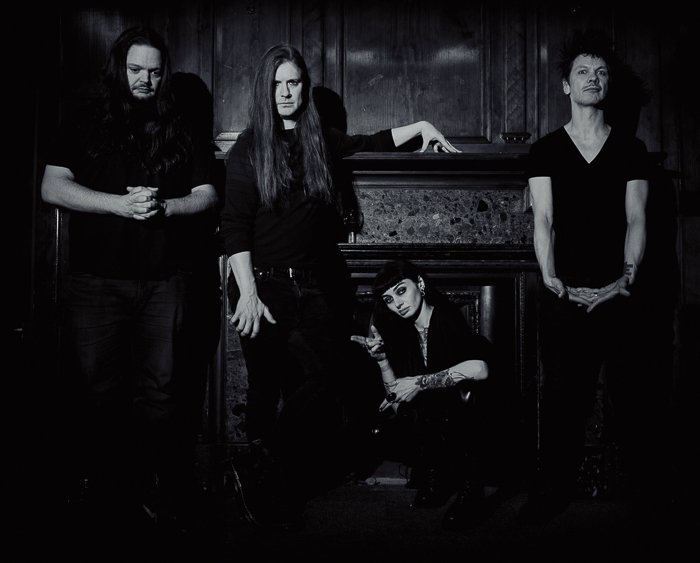
Ian: Let’s start with Sorrows. It’s your debut album, and it’s already getting attention for its atmosphere and emotion. What was the main inspiration behind the record’s sound and themes?
Agnes: It’s been lovely to see that atmosphere and emotion are what people are taking away from Sorrows. And I wish I could neatly sum up where it came from — if I could, writing album two would certainly be easier! ‘Inspiration’ is a tricky word. It implies a neat and convenient start to a creative process, which doesn’t reflect reality. There wasn’t a specific day where Sorrows was conceived; it came together retrospectively, after the work had been created.
There wasn’t an ‘I want to write a song that sounds like this’ moment. It was more of a lingering feeling. A background of anger and despondency, and grief, coming out of the pandemic. Some heavy times, and I’d been reading a lot of heavy things. I was feeling a bit lost when the songs were beginning to be written Working on them gave that period a focal point and a meaning of sorts. So the record is a way of writing through those feelings — a time capsule of a particular mood at a particular point in time, for both myself and Guy.
If you want to go really far back, the bones of Sorrows are in my childhood, in my mother’s record collection. Lots of post-punk and goth. Then the grunge and metal of my teenage years. All left to percolate for a long time, until this band became the thing that allowed it all
to surface. There were flashpoints — deciding to start writing music again, deciding to put the band together — but the songs were lingering somewhere in the background, just waiting for us to come together to find them.
Ian: The title Sorrows suggests something deeply personal and perhaps cathartic. What does the word sorrow mean to you in the context of this album?
Agnes: I love this question. To me, the idea of sadness has become almost fetishised in artistic expression. We think about sad songs; our bodies crave and need them. But there’s something different about true sorrowfulness.
I heard a Gaeilge speaker on TikTok recently, talking about how in Irish, you are not sad; the sadness is upon you. I thought that was a beautiful articulation of what we were trying to dance around. It comes full circle to laments and keening, which I was thinking about a lot as we wrote the album. The honouring of a moment of sorrow. Not something to be hidden away, or made private, or viewed as shameful.
The idea that you would honour a sorrowful transition or passing with song is something I’ve always found very beautiful and very healing. Not in a new-age, hippy-dippy way — in the literal sense of ‘to be healed.’ To remove what ails you, and to repair.
If we just allow ourselves to feel sad, that’s one thing. But if we allow ourselves to be with the sadness, to process it and honour it, then it can become something much more powerful. It can change the direction of your thoughts, or even your life.
The subject matter here is about being with complicated feelings — grief, rage, behaving impulsively. All the things that happen as a result of life events, world events, or even cosmic events. I’m not sure the purpose of life is to be happy all the time; I think it’s to be able to respond appropriately to the things we feel.
In contemporary society, we’ve lost the ability to confront complex feelings. When something terrible happens, there’s an impulse to mend from it as quickly as possible. But things take time. And when you’re in that time, you have to just be with it as you work through what comes up. That’s echoed in the artwork. They’re Georgia O’Keeffe’s hands, holding a thimble. The hands of a deeply practical woman. Hands that do the steady work.
So that’s what Sorrows means to us: to be in that mental space, to reflect, and to respond. Maybe this record is holding up a mirror — a physical reminder of our need to do that.
Ian: Can you talk us through the songwriting process — were these songs written over a long period, or did they come together once the concept of Sorrows took shape?
Agnes: The concept didn’t really take shape at the start; it wasn’t a deliberate attempt to write a record. On reflection, that kind of spontaneity might only happen once in your career — before you’ve released your first album, and before there’s an ambition to put something very deliberate together.
The band actually started because of the songs. We’d only intended to record an EP at most, but we had a number of finished songs, and being in the studio together felt so good that we just kept going.
There was a background intent that was really my drive to start writing music again, after a long hibernation. Some songs came with that mysterious urgency of creative projects you just need to get out of your body quickly. You have to do everything you can to be in the right place to catch them, whether by pen and notepad or in the studio.
I wrote ‘Wolfsbane’ and ‘Bodies’ in quick succession, back to back. Prior to that, I’d written ‘Embers’ as a piece of electronic music before I really had the lyrics, and sat with it for a while.
After we formed the band, we continued with deliberate songwriting. There were older ideas from myself or Guy that we mined and breathed new life into — a riff, a lyrical scrap, a general idea. The bulk of the set came together quite quickly, driven by excitement and the ease of playing together.
We’ve just started writing a second record, and it’s become a much more deliberate practice. People have listened to the songs now; they know them, they sing them, they’ve attached them to their own life experiences. That’s absolutely gorgeous, but in the songwriting
process, that weight of expectation can be challenging.
We know we need to live up to the hopes of everyone who loves the first record. We didn’t have that during Sorrows, and that frees you up. We were just writing because we wanted to write. Now we have to continue the promise we’ve made through our music, which is a somewhat different affair altogether!
Ian: Each single released from the album offers a glimpse into a different side of the band. How did you choose which songs would represent Sorrows ahead of the full release?
Agnes: This is a tricky thing. I’m a big believer in records as a piece of art to be considered in their entirety. As convenient as Spotify is, and as satisfying as it is to make a playlist — or a mixtape, back in the day — nothing really beats sitting down and being with a record for a while.
In some ways, it feels like an act of dishonesty to take a single song and ask it to introduce you to the world. Especially because we have a very particular sonic palette that is unmistakably ours. We take risks and do different things in our songwriting; we take a fluid approach to genre. We’re not afraid to move around and morph and flex, even within the same song.
We ended up picking a double A-side as our first release — a bit of a cop-out, perhaps, driven by what I just described! We led with ‘Reliks,’ which is ethereal and introspective before building to an enormous crescendo. The contrast was ‘Penance,’ which punches you right in the gut straight away. After that, we needed to offer up another face of the band.
It involved a lot of lengthy conversations and deliberation, because all of the songs are kind of like your children. To release any of them into the world is quite unnerving. You hope they’ll thrive, but there’s no great guarantee of that!
Ian: The production on Sorrows has a really distinctive atmosphere — dark, textured, and emotional. Who did you work with, and how did you approach capturing your live energy in the studio?
Agnes: Thank you for mentioning this. We spent a lot of time thinking about the details.
We recorded with Kevin Hare at Deep Storm Productions, and co-produced it with him. That meant Kevin had to be enormously patient with our ideas and our strong encouragement to do things beyond what you might consider standard sound production! We’re all at the point in our careers where we just wanted to make the thing we wanted to make. We weren’t fussed about whether it sounded ‘correct.’ There can be a bit of orthodoxy around these things, and that wasn’t something we were interested in.
We recorded a significant part of the album, certainly bass and drums, live. But it was important to have microphones freestanding in the room to capture the sound of the space. We didn’t want to lose any live energy — that weirdness and esoterica that comes from making music in a room. We were doing this thing that was important to all of us in a beautiful, rural, isolated location, and we wanted to keep the presence of that room in the recording.
For me personally, I realised quite quickly that I don’t like recording vocals standing static in a booth. I prefer being given room to manoeuvre — to wander around, crouch, bend, stretch, and leap. Whatever I need to do to encourage those sounds out of my body. So I taped together two very different microphones and had at it with a long cable, wandering around.
For mixing, we wanted to push the limits of reverb beyond what you would normally consider ‘reasonable.’ I also wanted to arrange my vocals like a choir, stacking them to create a wall of sound rather than a traditional lead-versus-backing structure.
Because we were comfortable with one another, and Kev trusted us, we were able to take what might look like creative risks in hindsight. But for us, it was a ‘yes, and…’ approach to see where it took us. We’ve got a beautiful record on the other side of it. Enormously grateful for Kev’s patience!
Ian: As a new band releasing a debut album, how do you feel the response so far has shaped your identity or confidence moving forward?
Agnes: It’s interesting to be thought of as a ‘new band.’ We are, really, but we’re not new to this. Our identity as musicians is pretty fully formed at this point because we’ve been plugging away at various things for a long time. Many of the band work professionally in music.
It’s more about shaping our identity as a ‘Cwfen’ together. That has been very natural. The name felt important because it reflected a coming together of people who trust each other and are engaged in the practice of making. We’re a strong friendship group; our lives coexist outside of the band. In many ways, one of the best things about it is that it’s a way for us to spend more regular time together. It’s great to spend time with your friends; it’s even better to make music with them when they’re excellent people and great musicians.
Putting this record out has been the realisation of a lot of individual dreams. All of us wanted to do this at some point, and the fact that it’s come together feels really special. That reinforces the love we have for one another, and it’s what we take on stage. It’s what gives us confidence: knowing you can trust each other. On the road, at practice, on stage — if something goes wrong, nobody is going to freak out. We’re all in it together. That gives you a sense that everything is going to be alright, and you can absolutely give it your all, however wee or enormous the stage is.
It feels like our identity has been in seed form for a long time, and this album is giving it the chance to bloom fully. We’re growing in creative confidence. Because we feel technically confident, and we’re so comfortable with the songs now, it allows us to take a few more of those nice creative risks. It’ll be interesting to see how that shapes the next record.
Ian: You recently completed your first UK headline tour. How was that experience?
Agnes: It was special. Playing our biggest shows to date at home in Scotland was wonderful, but the real magic was in places like Cardiff and Leeds — both sold out — which were genuinely some of the best shows of my life. To be in a place you’re not from, and to see people wearing your shirts and singing your songs, having travelled from far and wide to be there… that’s life-affirming stuff.
We met so many good people and were so warmly welcomed and looked after everywhere we
went. It just reaffirmed to all of us why we do this.
I came back from that tour immediately renewed and started writing for the second album. It
was so creatively nourishing. There’s something about taking the songs on the road and feeling them land with people that feeds you as a songwriter. It makes you want to give them more.
Ian: Are there particular songs from Sorrows that you’re most excited or nervous to perform live for the first time?
Agnes: Maybe it’s a cheat of an answer, but I feel excited and nervous about all of them in equal
measure. We love playing these songs; there aren’t any we’re bored of yet.
It really does feel like a privilege to take them to a new audience and see their reactions for
the very first time.
Personally, I’m always a bit of a baby when it comes to singing ‘Embers’ because it makes me cry. I always have to shut my eyes at the beginning to centre myself and make sure I don’t become a bubbling mess. I find it very emotional in terms of the intensity and the content, and it’s usually the one that changes the mood in the room, which is really special to watch. I feel I have to do that one justice.
The couple of new songs — those are the ones that make me terrified! But it’s only a couple, so there’s plenty of time to get them right. Famous last words!
Ian: You’re currently on tour with Paradise Lost across Europe, with Irish dates in Belfast, Dublin, and Limerick coming up in March. How did
that opportunity come about, and what does it mean to you to share the stage with a band of that legacy?
Agnes: We are still having to pinch ourselves over this one. We’re currently out with them across the Netherlands, Germany, Denmark, Norway, Sweden, and Finland, and it has been a dream. It feels a bit mad knowing it’s our music that’s taking us on this journey.
This came about thanks to our booking agency Northern Music who have been brilliant from the moment we started working with them following our Faetooth run last year. They’re very good at connecting the dots between established and emerging artists, so we have them
entirely to thank for this. And a big thanks to Paradise Lost for believing in what we do enough to invite us along. That means an awful lot.
In terms of sharing a stage with them — it’s a dream scenario. We’ve been listening to them for a long time, and as fans we’re particularly aware that they are pioneers in this genre and one of the finest musical exports from the UK. There’s a real sense of pride in how they’ve represented this wee island around the world. There’s also enormous admiration for the fact that they’ve been a stable unit of colleagues and friends, making great records and touring
consistently, for as long as they have. We’re really inspired by that, and hoping to learn a thing or two on the road.
In all seriousness, it really is a dream come true. Proper teenage fantasy stuff!
Ian: The Irish shows will be your first time playing on Irish shores. How are you preparing, and what are you most looking forward to about meeting Irish audiences?
Agnes: There is so much we’re looking forward to. Ireland is somewhere that’s important to all of us.
When you’re from the West of Scotland, it’s fairly common to have strong Irish ancestry and connection. It feels particularly special to make that trip and play music there, especially for a people known for their musical talent and who love music so deeply.
Irish audiences are known for being emotionally and musically open, and unafraid of intensity. There’s an alignment there with what we’re trying to do. The songs are raw, emotional, and cathartic. We share an understanding of the power of a good song and how good it feels to sing. How necessary it can be.
There’s also a cultural resonance in the themes I write about: grief, spirituality, liminality, the stories of women, the landscape, and lapsed Catholicism. I think that has roots in a shared cultural imagination.
When I was writing for this record, I was reading a lot of literature and poetry from Ireland. When I was thinking about the artwork, I was reading A Ghost in the Throat by Doireann Ní Ghríofa, and about Eibhlín Dubh’s Caoineadh — how she drank the blood of her slain beloved from her own hands and what that meant. That image hit me like a truck; it’s actually what made me think to put red hands on the cover.
There is so much I love from an art and culture perspective that comes from across the water, so it feels humbling to be coming your way because of the art we’ve made. I’ve also been lucky enough to spend time in Dublin, and have seen firsthand the response you get from a crowd. We’re honoured that Paradise Lost have given us this opportunity to play somewhere that matters so much to all of us.
Ian: Sorrows feels like it comes from a place of emotional honesty and creative risk. Looking ahead, how do you see your sound evolving after this first chapter?
Agnes: It did, in the way that perhaps only brand new records really can, without the weight of expectation. To start any new thing is creatively risky; there’s no promise of reward or even acceptance. We were trying to get across a sort of ‘felt truth,’ rather than a socially acceptable or narratively tidy version of what we wanted to express.
But now the songs are living in a state of tension between creators and listeners, because they mean something to both groups. With the next album, we’ll be thinking about the listener, who didn’t really exist before. Back then we could fart around and do whatever we liked! And it just so happened that we landed on our feet. So I’m feeling a sense of expectation, but trying not to be intimidated by it.
Our sound is pretty dialled in now, as a result of playing live and tweaking what we do in the room. We know what a Cwfen song feels like in terms of atmosphere, emotion, and texture. Where it will evolve is in the recording, informed by a year or so of playing the songs live, knowing what we can do on stage with just the four of us and no tracks, and then thinking about how we bring that back into the studio.
I still see us coming to the studio with songs fairly fully formed; I don’t think the studio is where we do our best writing. We want to have our songs bedded in and under the fingers before we commit them to a record. We’ve got a few new songs in the works, and played a couple recently to some really good feedback, which is encouraging.
It’s been a year of deep listening for me, and that’s the pasture your new songs are raised on. Hopefully you’ll hear some of that in what comes next.
I’m much more confident in the dynamics of my heavy vocals now, and I have a good sense of what I can manage on stage night after night. I didn’t know what my voice or my body could handle when we wrote Sorrows, and I had to find a way to make that work live. I don’t want to be curtailed by thinking something might be too intense or experimental to get away with on stage. I still want to push myself. We all do.
Ian: Finally, for people discovering Cwfen for the first time through Sorrows or your upcoming tour, what do you want them to take away from your music?
Agnes: One of the most meaningful things has been hearing what the album has meant to people. Knowing it’s been there for them through difficult times, heavy times. It has made them think and feel things, or articulate feelings they weren’t quite able to express themselves.
Some of the most important records in my collection are the ones that spoke to me, the ones I can come back to whenever I need that particular message again. I’d like to think this record could do that. It was made with intention, with a depth of feeling, and an acknowledgement of the complexity we have to deal with in our lives.
But in terms of coming to see us live — it’s maybe something more visceral than that.
Lots of people spend a lot of money going to very big shows these days. There’s a lot of polish, and a lot of people in the crowd. Sometimes you can feel connected, but I often find it can make you feel further removed from the thing you love.
I was at a show just the other night where a couple of friends’ bands, Omo and Cutty’s Gym, were playing one of the smaller venues in Glasgow, and it was absolutely on fire. People up on the seats, throwing themselves around; febrile and unpredictable and delightful and messy and hard and sweaty. People coming off the stage into the crowd, getting in people’s faces.
It made me realise how special it is to play gigs of that size, where you’re counted amongst a select few who are there just because you absolutely love this thing happening in front of you.
If you’re coming to a Cwfen show, that’s what I hope you’re going to feel. We are going to give it our all. It’s not going to rely on big effects or polish. It’s just going to be us. Four humans, playing the absolute shit out of our songs, in the hope that it might mean something to someone out there in the crowd.
Irish Dates with Paradise Lost:
20th March – Limelight 2, Belfast
21st March – Academy, Dublin
22nd March, Dolans, Limerick
Tickets – https://paradiselost.co.uk/tour-dates/
Words – Ian Mc Donnell @mcgigmusic
Photo credit – Adam Moffatt