Ian: The Last Stand has just had its 10th anniversary release (16th of September), and the new limited 10th Anniversary Edition is being described as the “definitive” edition, with the bonus material finally brought together. Looking back at the album with ten years of hindsight, what does The Last Stand mean to Sabaton today, and is there anything about the album you hear differently now than you did in 2016?
Pär Sundström: The concept of “last stands” fits perfectly with heavy metal and writing great songs, and it was a topic we really enjoyed working on. After the album was released, we were bombarded with topics from fans that would have suited The Last Stand part 2. At the time of writing, we were proud of all the topics we chose and how the songs came together.
At the launch of the album, we felt that there were more interesting songs than the title track. Today, we have proof that the fans have decided that “The Last Stand” is, and has been, the most popular song among Sabaton fans.
Ian: The new edition also includes previously unseen live material from Sabaton Open Air 2016, a particularly interesting snapshot of the band at that point in its history. When you watch that footage today, what memories come flooding back and do you see a very different Sabaton on that stage compared with the band you are today?
Pär Sundström: Yes. The show was selected because it was the last show before Thobbe went off on an eight-year break from the band. At that point, we believed it was going to be his last-ever Sabaton show, which is why we decided to call it “Thobbe’s Last Stand”. For all of us, it was a very emotional evening, and it was emotional for the crowd too.
Even though we are now back with Thobbe, it’s a different Sabaton. The reason he decided to leave was because he was a bit tired of touring at that moment in time. Now, he is excited to tour, so that has completely changed for him and has spilled over to the rest of us. It’s much nicer to tour with a happy Thobbe than a tired Thobbe.
Ian: Your 2025 album Legends continued Sabaton’s tradition of turning extraordinary historical figures and events into heavy-metal stories. After spending so much of your career telling other people’s stories, what makes a particular historical figure or event immediately feel like a “Sabaton song”?
Pär Sundström: We always create the music first, and it is the Sabaton motto that metal comes first. When we sit with the music, we try to imagine what topics fit the exact sound that you’re hearing.
When working with a topic like “Legends”, there is so much in there to explore. We can focus on the dark deeds of the figures we sing about, or the glorious, sad or happy moments, depending on which point in history we choose to show them.
Since most of the characters we sing about on “Legends” have shown all sides of their emotions and character, they can usually fit into various types of music, which is helpful when writing an album with a concept like this.
Ian: Legends and The Last Stand represent two very different chapters of Sabaton’s history. When you put the songs from Legends alongside the classics from The Last Stand, what do you think has changed most in the band’s songwriting, sound and approach to storytelling over the past decade?
Pär Sundström: I don’t think that we have fundamentally changed a lot in the way we write music. I think we’ve become a little bit better, in the same way that a high jumper gets a couple of extra centimetres better after a while, but hasn’t changed that much in what he does. We work better together as a band and we know our strengths better, but when it comes to the music, we have never really forced ourselves to write something in a specific direction. We have just let the music be what it was in the moment.
Ian: You recently released “Yamato” as a standalone single, rather than including it on Legends. Given that the story of the Japanese battleship fits so naturally into the Sabaton universe, why did you decide that “Yamato” needed to exist as its own standalone chapter rather than becoming part of an album?
Pär Sundström: “Yamato” builds on the legacy of “Bismarck”, which was also a standalone single released just before “The Great War” album in 2019. “Bismarck” was a fan request, and after it was released, the fans started requesting that we do a song about Japan’s Yamato battleship.
Everything has its time and place, and it took a few years for us to find the right music. Ever since we released that song, fans have now started requesting a different topic, which we will not reveal now. But who knows? At some point, maybe we’ll do another fan-requested song!
Ian: You have described “Yamato” as something of a follow-up to “Bismarck”, while also pointing out that the song isn’t technically part of Legends. Was there something about Yamato’s story particularly its final mission and the way the ship became a symbol that demanded a different musical treatment from the stories on Legends?
Pär Sundström: “Yamato” takes place during the last part of World War II, while the rest of the stories on the “Legends” album are much older. Musically, the song “Yamato” also stands out, partly because it was written by our previous guitar player, Tommy, and we felt that the song was able to stand on its own.
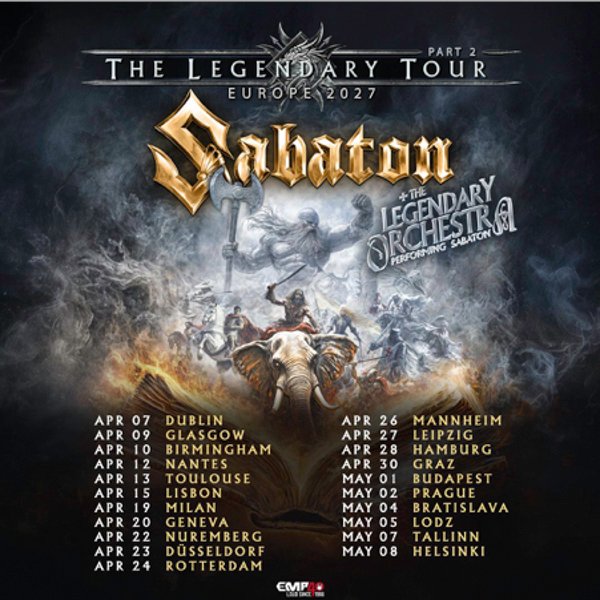
Ian: The first Legendary Tour was an enormous production, and Part 2 will once again feature The Legendary Orchestra, alongside Noa Gruman, Tina Guo and Mia Asano. How do you approach arranging Sabaton songs for such a large scale orchestral setting without losing the raw power and aggression that makes them heavy metal in the first place?
Pär Sundström: The strength of any song, in any genre, in my opinion, lies in the melodies, and I think that’s where a good songwriter can triumph, no matter what the genre is. Sabaton’s songs rely heavily on good melodies, and that makes them work well when it comes to translating them into other genres.
With the help of the very talented Joost van den Broek, who has a lot of experience in arranging for orchestras, he undertook the arrangements for The Legendary Orchestra and also helped us find the right people and the right sound for The Legendary Orchestra.
Ian: Noa Gruman, Tina Guo and Mia Asano each bring very different musical identities to the show. What do their individual performances add to the Sabaton live experience, and are there particular songs where you think each guest will completely transform the way the audience hears them?
Pär Sundström: They are all extremely talented musicians, and they bring everything they are, and a little bit more, to The Legendary Orchestra. They all love to perform on stage, which can be seen in everything they’ve done before and will do here as well.
I, personally, am confident that they can carry this and be the front figures in large-scale arenas, making fans satisfied even though the Sabaton songs are not being performed with the traditional guitars and drums.
They all have their special moments when they really shine, especially when their individual performances are brought to the forefront of the orchestra.
Ian: The Legendary Tour – Part 2 kicks off its European run at Dublin’s 3Arena on April 7, 2027, marking Sabaton’s first Irish show in more than a decade. Why was Dublin chosen as the starting point for the European leg, and what does it mean to begin
such a huge production in Ireland?
Pär Sundström: As you mentioned, we haven’t been to Ireland for a while, and it was one of my priorities to make sure that we have a show in Ireland where we can properly show what Sabaton is all about!
Ireland being a little bit remote, while also offering a great arena, makes it an ideal starting point.
Ian: Sabaton’s live shows have become increasingly theatrical, with enormous sets, storytelling and spectacular production. After the experience of the first Legendary Tour, what did you learn about putting on a show of that scale — and what can fans expect from Part 2 that they haven’t seen before?
Pär Sundström: While Sabaton’s strength lies in the music, and we feel comfortable performing without any spectacle, we do enjoy being able to bring visual life to the stories that we are telling. Being massive fans of bands that brought a big spectacle and a big show when we were growing up has naturally influenced us to want to do the same ourselves.
I am a fan of entertainment, and we are always thinking about ways to make our show more entertaining. Indeed, the previous tour was large, and this one will be nothing less!
We will adjust a couple of things, we will improve a couple of things, and we will tailor the second tour to feel fresh while still maintaining the core of the first part of The Legendary Tour.
Ian: You’re bringing together material from across Sabaton’s history including songs from Legends and the band’s established classics while simultaneously celebrating the 10th anniversary of The Last Stand. How difficult is it to build a setlist when you have so many songs that fans consider essential, and is there one The Last Stand track that you particularly want to hear the Dublin crowd sing back at you?
Pär Sundström: Yes, it is very difficult to create a setlist for Sabaton in 2026. We have a lot of fan favourites, we have a lot of band favourites, and in some cases, we also have local songs that become essential to include in the setlist depending on where we are playing. All in all, this makes it difficult to create a setlist.
On the positive side of things, we now have The Legendary Orchestra that performs Sabaton songs, allowing us to concentrate on other songs. The fans are now able to hear more of our songs than ever before – it’s a win-win!
As for the second part of the question, there is a song on “The Last Stand” that we have never performed live – “The Last Battle” – which was also voted by fans as the most underrated song. We are always searching for an opportunity to bring this song to the stage, and I look forward to that moment.
Ian: Sabaton has spent more than two decades turning history into songs that connect with audiences who may have very different backgrounds and nationalities. When you look ahead to the next chapter after Legends, the The Last Stand anniversary and the 2027 Legendary Tour, what kind of story is still waiting for Sabaton to tell?
Pär Sundström: Unfortunately, humanity has been cruel, and throughout the tens of thousands of years that we have lived, we have also waged war, so there is no lack of content for us to write stories about. Quite the opposite! Exactly where we will look to in the future has not been decided yet, because there’s still a lot of life left in “Legends” yet!
IRELAND TICKET– DETAILS
Sabaton – their first Irish show in over a decade at Dublin’s 3Arena on April 7, 2027.
Tickets from ticketmaster.ie
Prices: €82.35 / €92.35 / €102.35
Subject to 12.5% Ticketmaster service charge per ticket (max €10.50).
The Last Stand (10th Anniversary Edition) here:
https://nblast.de/thelaststand_10y